
Antioch & State Rail Roundup
Antioch Rivertown Hosts Halloween Event as High-Speed Rail CEO Resigns
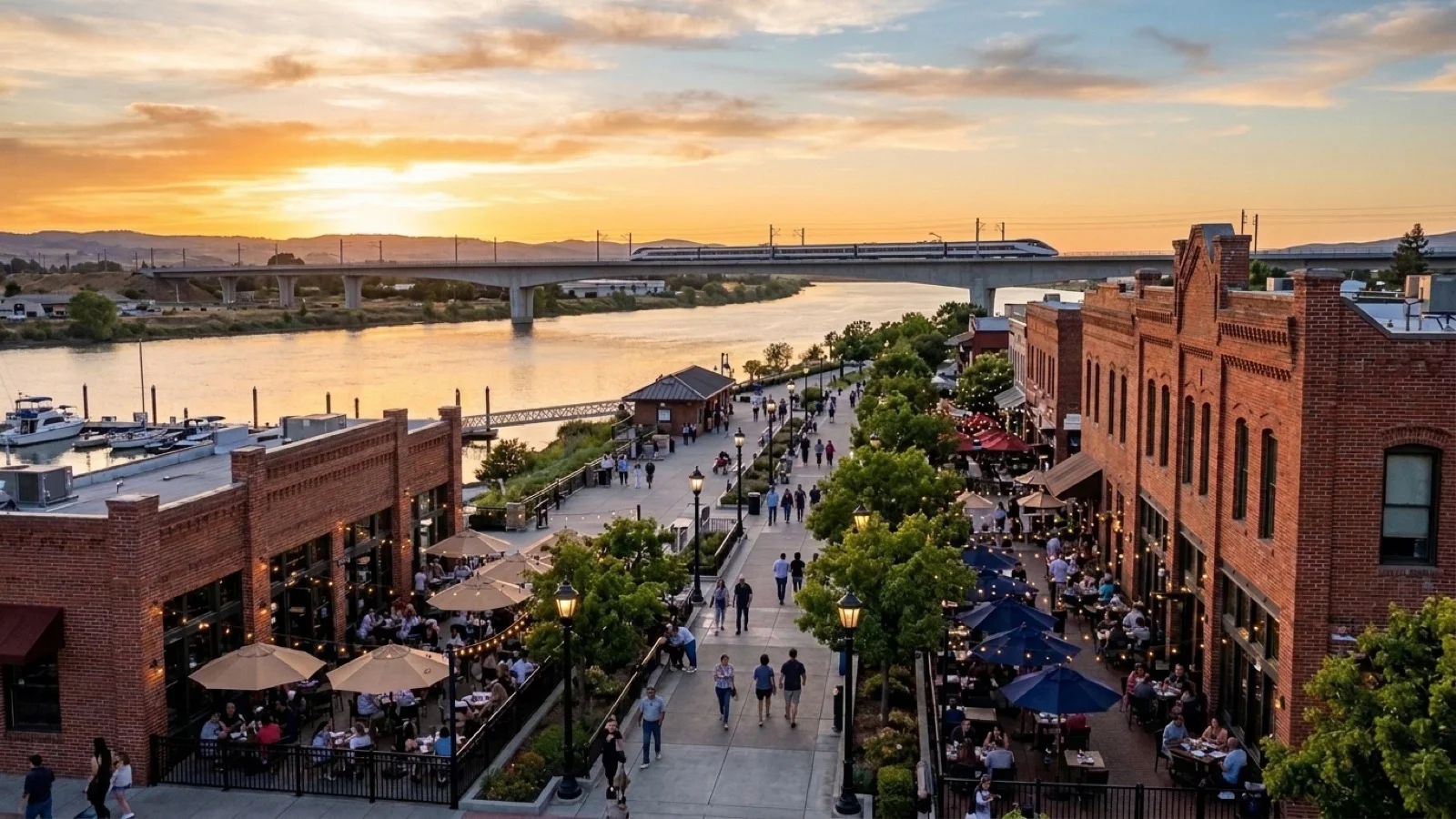
The Four Seasonings Steakhouse in Antioch prepares for Saturday night Halloween festivities while California High-Speed Rail Authority CEO Ian Choudri steps down during a board meeting that approved a $772.1 million Siemens train contract.
Your listening Queue & catch up
Add a story or build a catch-up queue to start listening.
Waterfront dining venues in Antioch's historic downtown Rivertown district are preparing for Halloween weekend events, while at the state level California High-Speed Rail Authority CEO Ian Choudri resigned late Wednesday, October 28, 2026, ahead of Thursday, October 29, 2026 board sessions amid an inspector general probe into consultant travel expenses.
In Antioch, the Antioch Herald reported that The Four Seasonings Steakhouse in historic downtown Rivertown (www.the4seasonings.com) is hosting a Saturday night Halloween celebration. Also in Antioch, waterfront restaurant Monica's Riverview opened early Thursday morning to air the 9:30 a.m. Pacific broadcast of WNBA Finals Game 6 between the Golden State Valkyries and the Atlanta Dream.
California High-Speed Rail CEO Ian Choudri Resigns Amid Travel Expense Probe
In statewide transportation news reported by CalMatters and published by The Almanac and Mountain View Voice, California High-Speed Rail Authority Chief Executive Ian Choudri resigned late Wednesday in the middle of a two-day board meeting, writing in an emailed resignation letter that he needed to focus on "important personal and family priorities."
Choudri was hired in August 2024—when Tom Richards served as board chair—after working on high-speed rail projects in France and Spain. According to agency spokesperson Annie Parker, Choudri's compensation this year is more than $534,000, and agency spokesperson Micah Flores told CalMatters last month that the board had been scheduled this week to decide whether Choudri qualified for a potential $25,000 performance bonus. During Wednesday's meeting, rail authority chief of staff Mark Tollefson presented an overview of Choudri's efforts to attract private investment and speed up contracting.
Choudri's resignation followed an inspector general investigation into nearly $600,000 in questionable trips and nearly $1.3 million in reimbursements paid by four consulting firms between 2024 and 2026. State investigators found that employees from four consulting firms billed taxpayers for first-class flights, premium rides, and visits to gyms, a nightclub, an escape room, a tiki bar, a cigar lounge, and restaurants—including trips to Folsom, the Sacramento suburb where Choudri has a home. One legal consultant traveled between Denver and Sacramento 30 times in a year, charging the state $86,500 in "travel time" payments and $40,800 in reimbursements. Under a CalMatters public records request, heavily redacted invoices were released from only one firm, Nossaman. Earlier this month, the board limited Choudri's contracting authority to require in-house legal counsel sign-off on contracts under $25 million, and on Wednesday authority staff reported that the four consulting firms have paid nearly $1.3 million in reimbursements.
Board Approves $772.1 Million Siemens Mobility Contract for 3 Bullet Trains
On Wednesday, the board unanimously approved a $772.1 million contract plus up to $63.7 million in import duties for three seven-car trains by 2030 with Germany-based Siemens Mobility, Inc. to design, build, and test three seven-car high-speed bullet trains. The vote came three years after the agency first opened bidding for six trainsets in August 2023 to qualify for more than $3 billion in federal grants; under Choudri, the authority lost $4 billion in federal funding under President Donald Trump's administration after missed deadlines and dropped its federal lawsuit in December 2025, while Gov. Gavin Newsom has committed $1 billion a year from the state's climate fund through 2045.
California voters originally approved a $10 billion bond in 2008 to build a San Francisco-to-Los Angeles system by 2020 at a projected cost of $45 billion. The authority's latest business plan estimates full buildout by 2040 at $126 billion to $231 billion, with the 171-mile Merced-to-Bakersfield leg expected by 2034 at a cost likely exceeding $40 billion and the inspector general warning in July that the agency could run out of cash by December 2027. This month, the Central Valley coalition Community Alliance for a Sustainable Economy also filed a lawsuit challenging the authority's proposal to shrink the Merced-to-Bakersfield segment by 9 miles and relocate the downtown Merced station to South Merced.
Sources
Comments (0)
No comments yet. Be the first to share a thought on this story.